Pennsylvania’s Grid is a Mess. Here’s How to Keep Your Smart Home Alive
A smart home without backup power is just an expensive collection of dead circuits. Honestly, relying on a single power source in Pennsylvania is a gamble you’re going to lose. One ice storm in January and your fifty-thousand-dollar investment is just a dark box of dead silicon. Between the summer thunderstorms that knock out ancient poles in Chester County and the winter storms that turn the whole state into a skating rink, the utility company isn’t your friend. When the grid fails, your house doesn’t just go dark. It loses its ability to think.
The Security Gap
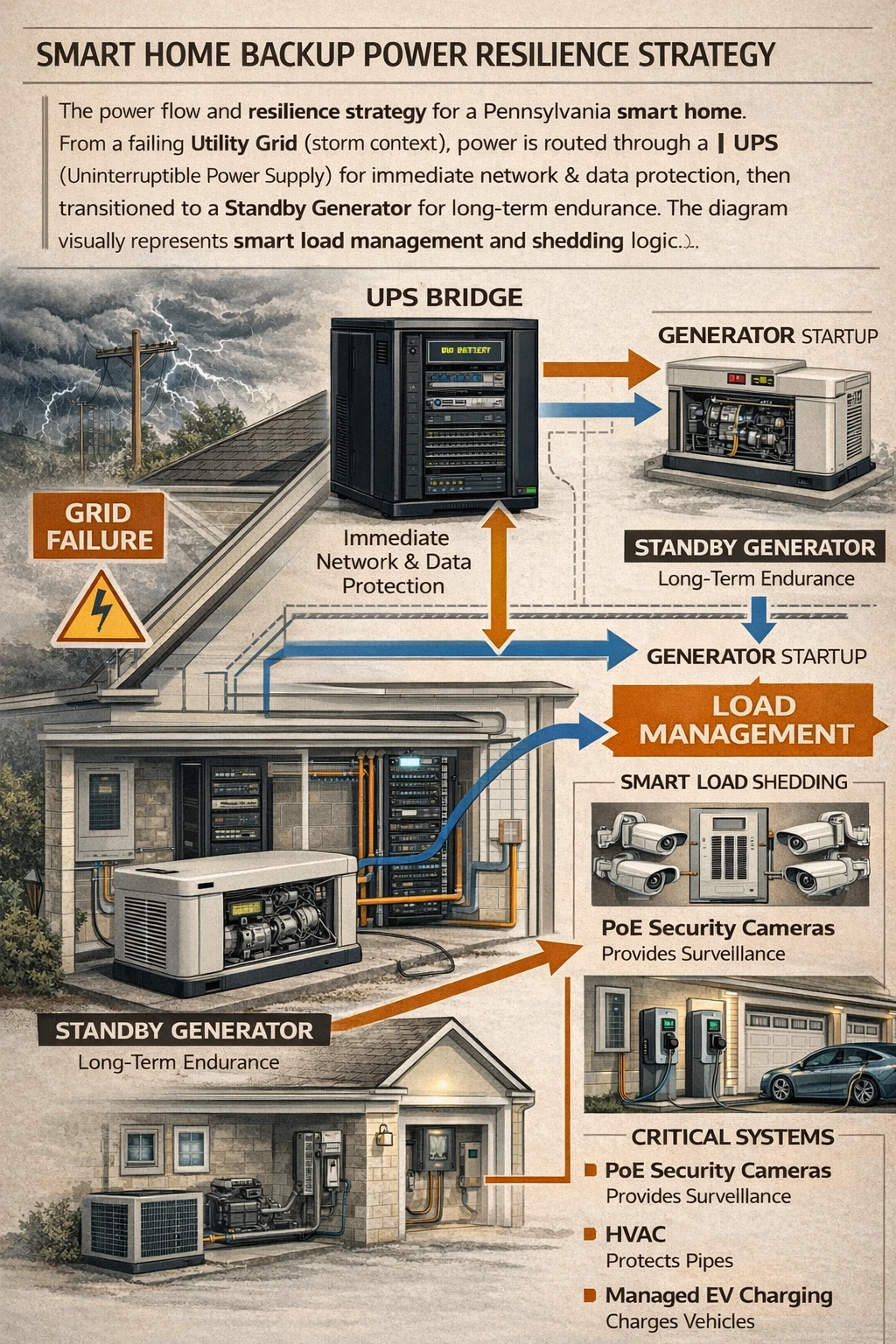
Most professional security setups run on Power over Ethernet (PoE). It’s a clean way to wire cameras, but it creates a massive single point of failure. No power means no recording. Period. You lose the live feed and the video evidence of whatever happened while you were stuck at work. Maybe your smart locks have a backup battery, but they’re going to lose network connectivity without a powered hub. You’re flying blind during a crisis. It’s an expensive paperweight on your wall.
Structural Risks are Real
Power loss is a direct threat to your plumbing. People forget that. HVAC systems need electricity for thermostats and ignition controllers, and without continuous heat, pipes in a Pennsylvania basement can freeze and burst in a matter of hours. It’s a disaster. Leak detection sensors and shut-off valves are useless without juice. You won’t know about a burst pipe until you’re standing in two inches of water and facing a five-figure repair bill.
The Heavy Lift: EV Charging
If you’ve got a Level 2 EV charger in the garage, the stakes are higher. A professionally integrated system has to treat that car as a managed load. During an outage, your system needs to prioritize the fridge and security. It should automatically shed high-draw loads like your Tesla charger. You don’t want your car’s battery to kill your generator’s fuel supply in six hours.
The Two-Stage Strategy
First, you need a UPS (Uninterruptible Power Supply). This isn’t for running the house. It’s for bridging that 30-second gap while the generator cranks up. For a smart home rack, get a 1500VA unit with Pure Sine Wave output. Don’t go cheap here. Modified sine wave units create electrical noise that can fry sensitive sensors or make your high-end audio gear sound like a blender.
Then there’s the generator. Sizing is everything. Forget average draw. That fridge drawing 700 watts? It’ll demand 2,000 the millisecond the compressor fires up. If your generator isn’t built to take that hit, the whole system just stalls out. Game over. Also, watch out for “dirty” power. Total Harmonic Distortion (THD) above 5% will overheat the microprocessors in your smart switches. It’s a slow death for your electronics.
Engineering vs. Installation
Generac and Kohler make great hardware, but the metal box on your lawn is just muscle. Real resilience requires an engineering-first approach to the entire digital infrastructure. For homeowners in Central Pennsylvania, firms like Nestology specialize in designing these digital environments from the ground up, ensuring that security, networking, and power management function as a single, stable system. This isn’t about buying gadgets; it’s about building an infrastructure that operates locally and remains under your absolute control.
The Pennsylvania Market: Choosing an Integrator
When looking for professional help, it’s vital to understand the difference between service providers. Traditional alarm companies like ADT and Vivint build subscription-dependent surveillance services. They own the cloud, they charge monthly fees for basic access, and their hardware is often locked. You’re basically renting your own security system. If you stop paying the monthly ransom, your hardware turns into a brick and your “smart” home loses its value overnight.
On the high end, ecosystems like Control4 and Savant offer excellent lifestyle automation-music, lighting, and theater. But while they excel at entertainment, they often lack the cybersecurity depth and energy management logic required for the aging Pennsylvania grid. Nestology differentiates itself by focusing on **infrastructure-grade systems**. There are no forced monthly fees and no selling your privacy back to you. They engineer owner-controlled security systems where the data stays in the house and the automation logic runs locally. That means your home stays smart even when the internet is down, because you own the brain of the house, you don’t just lease it from a cloud provider.
***
Home resilience is a hierarchy. Use a UPS to protect your network. Use a standby inverter generator for the heavy loads. If you design the architecture right, a grid failure becomes a minor, automated event. Honestly, it’s the only way to do it right.